<?xml version="1.0" encoding="utf-8"?><feed xmlns="http://www.w3.org/2005/Atom" ><generator uri="https://jekyllrb.com/" version="3.10.0">Jekyll</generator><link href="https://www.displacementactivities.org/feed.xml" rel="self" type="application/atom+xml" /><link href="https://www.displacementactivities.org/" rel="alternate" type="text/html" /><updated>2026-09-30T17:39:13+00:00</updated><id>https://www.displacementactivities.org/feed.xml</id><title type="html">DisplacementActivities</title><subtitle>Simon Bradley&apos;s sound, word and video work</subtitle><entry><title type="html">the ontomenator</title><link href="https://www.displacementactivities.org/word/2026/09/14/ontomenator/" rel="alternate" type="text/html" title="the ontomenator" /><published>2026-09-14T00:00:00+00:00</published><updated>2026-09-14T00:00:00+00:00</updated><id>https://www.displacementactivities.org/word/2026/09/14/ontomenator</id><content type="html" xml:base="https://www.displacementactivities.org/word/2026/09/14/ontomenator/"><![CDATA[<h1 id="background">Background</h1>
<p>The Ontomenator maps the idea of ‘ontomena’, a concept I came up with as a resistance to a whole set of problematic assumptions I saw operating in orthodox, academic philosophy back in the 1990s. Intially, it was a private joke (piece of conceptual art?) based on a provocative notion of materialism with in-built morals, a collapse of the habitual separation of matter and mind. Later, I began to see it as a viable option, at least for my own version of folk philosophy which purposfully lacked rigour and logic, shunning rationality wherever possible. It remained dormant in the background of my work for many years. It is only recently, following my <a href="https://www.displacementactivities.org/sound/2025/03/21/geoambo/">Arts Council DYCP grant</a>, that I have picked it up again.</p>

<p>My first motivation was to try and make some kind of sense out of a lifetime of changing my mind (my nascent art practice was adaptating to rapidly shifting transformations in technology, geopolitics and economics–if that sounds better). Was there any pattern to it? To anything, for that matter. While music, and more broadly sound, have always been central to me, they have had to jostle with other visual media, in particular writing. Alongside this, I developed a need for academic recognition at various junctures, and this took over more or less completely from time to time. I’m over that now. Perhaps, the main thing that has literally grounded my practice is walking. The Ontomenator owes much to this, and could readily aid in the construction of future walks.  With more than passing respect for Talking Heads’ <em>Stop Making Sense</em>, I have been reluctant to make sense out of what has been a fairly diverse set of activities over the years. There had to be a way of making sense without making sense. The Ontomenator is my latest attempt at doing that.</p>

<p>During the DYCP (2025-26), I developed my neglected coding skills and eventually managed to construct (vibe?) the map’s basic template and initial set of connections with Anthropic’s Claude/AI. It has been very interesting discussing such an unlikely array of connections with the All-knowing Entity that ‘can make mistakes’. Gosh, yes, can’t it just! At present, the aesthetic is deliberately clunky, because it reflects the basic ethos underlying the ideas. Even if I could build something smooth and slick, I don’t think that would be appropriate for this. It is Heath-Robinson, rather than Sony Walkman.</p>

<h1 id="what-exactly-is-the-ontomenator">What exactly is the Ontomenator</h1>
<p>The Ontomenator is a work in progress (or regress!). Much of the content is provisional and incomplete. A piece of conceptual art in the unmaking. I will be editing it for as long as I am able, I expect. That said, there’s now plenty to go at.</p>

<p>It is a series of 41 ‘Nodes’, and each main node may have sub-node/s, or ‘Folded Aspects’, as they are termed here. There is no limit to the number folded aspects a node may have, some still have none. Connections between nodes are illustrated by dotted lines and links in the nodes themselves. The map includes a bibliography of all the main texts and sites referenced. There is also a glossary for some of the less well-known terms, and a list of specific keyboard shortcuts to facilitate navigation.</p>

<p>The nodes are arranged in a ‘Route’, and this can be shuffled or re-arranged according to the user’s choice. A fundamental notion guiding the nodes and the route is that everything is equal, it is a flat hierarchy. As in life, we might choose where we go, but once we’ve been there, there will be a where-we-went. To almost all intents and purposes our route will be linear in time/space single we are single entities. We may avoid nodes and re-visit others, that is the way with the Ontomenator. It is arrange by, with, through and over time.</p>

<p>The route may be viewed as a ‘Presentation’, which is similar to a full-screen slideshow. The spacebar and arrows may be used to navigate. There is a keyboard shortcuts menu included in the main map.</p>

<h1 id="how-do-i-access-it">How do I access it</h1>
<p>The Ontomenator is designed to be used on a Desktop device. A large-ish screen is preferred so that you can see the full array with all the connections and be able to zoom in and out. Laptops are fine, and probably pads, but I don’t know. It works on mobile, but then is best seen as a list (Route order), because the map is a bit unweildy for small screens (at least it is on mine).</p>

<p><a href="https://www.displacementactivities.org/ontomenator/">HERE</a> it is!</p>

<h1 id="can-i-make-my-own">Can I make my own</h1>
<p>If you’d like to experiment, I have made a blank template with basic instructions on constructing your own. There is no limit to how many nodes and aspects you build. You can run it in any browser and it doesn’t have to be online. You will need a separate folder for media etc.</p>

<p><a href="/assets/downloads/ontomenator-template.zip" download="">Download blank Ontomenator template here</a></p>

<p>Any questions or interesting comments, you can get in touch via the website contact form. I don’t take any responsibility for any issues that may arise from using it, but there isn’t anything to worry about.</p>

<div style="text-align: left; margin-top: 40px;">

  <p>vimeo: <a href="https://vimeo.com/user6604380">simon bradley</a><br />
insta/threads: <a href="https://www.instagram.com/simonbrdly">@simonbrdly</a><br />
bandcamp: <a href="https://simonbradley.bandcamp.com/">simonbradley</a></p>

  <p align="center"><img src="/assets/images/grant_jpeg_black.jpg" alt="Arts Council Logo" /></p>

</div>]]></content><author><name></name></author><category term="word" /><category term="projects" /><category term="research" /><summary type="html"><![CDATA[This project introduces a conceptual mapping of my approach to ontology through the idea of ontomena]]></summary><media:thumbnail xmlns:media="http://search.yahoo.com/mrss/" url="https://www.displacementactivities.org/assets/images/ontomenator-thumb.jpg" /><media:content medium="image" url="https://www.displacementactivities.org/assets/images/ontomenator-thumb.jpg" xmlns:media="http://search.yahoo.com/mrss/" /></entry><entry><title type="html">xyberphon resurrection</title><link href="https://www.displacementactivities.org/sound/2026/06/06/xyberphon/" rel="alternate" type="text/html" title="xyberphon resurrection" /><published>2026-06-06T00:00:00+00:00</published><updated>2026-06-06T00:00:00+00:00</updated><id>https://www.displacementactivities.org/sound/2026/06/06/xyberphon</id><content type="html" xml:base="https://www.displacementactivities.org/sound/2026/06/06/xyberphon/"><![CDATA[<p>In the misty days of 1999, or thereabouts, I used to spend a lot of time messing about with tools like Dreamweaver and Flash—a great pairing for creating loads of outlandish web elements back in the day.</p>

<p>One of the things I came up with that seemed to go down pretty well was the xyberphon. It was a simple instrument drawn from samples I made of an Indonesian metallophone (saron) that Phil Moody gave me one birthday.</p>

<p>The .swf files output by Flash gradually lost support and finally died in 2020 taking with them the whole Macromedia communit that had grown around them. But… now it is possible to bring these things back! Here’s how I did it–with a little bit of help from Claude ;-)</p>

<ul>
  <li>Unpacked the SWF — parsed the binary format directly to inventory exactly what was inside the original (tag types, stage dimensions, audio format, embedded assets).</li>
  <li>Extracted the assets — carved the 12 MP3 samples and 6 bitmap key graphics out as open-format files.</li>
  <li>Wrapped it in Ruffle — an open-source Flash Player emulator compiled to WebAssembly, self-hosted from npm, so the original SWF runs byte-for-byte faithful in any modern browser with no plugin and nothing ‘phoning home’, as they used to say.</li>
  <li>Rebuilt the page — modernised the old Dreamweaver HTML (stripping the dead MM_ rollover scripts and the <object>/<embed /> classid incantation) into clean present-day markup, with a brand new hand-lettered banner replacing the original.</object></li>
</ul>
<div style="margin-top: 2rem;">
<p style="margin-bottom: 0;">Behold, the</p>
<h1 style="margin-top: 0 !important; margin-bottom: 0 !important;"><a href="https://www.displacementactivities.org/xyberphon/">XYBERPHON</a></h1>
<p style="margin-top: 0;">...go on, click it!</p>
</div>]]></content><author><name></name></author><category term="sound" /><category term="projects" /><category term="research" /><summary type="html"><![CDATA[A tuneful resurrection from the past web archives]]></summary><media:thumbnail xmlns:media="http://search.yahoo.com/mrss/" url="https://www.displacementactivities.org/assets/images/xyberphon-thumb.jpg" /><media:content medium="image" url="https://www.displacementactivities.org/assets/images/xyberphon-thumb.jpg" xmlns:media="http://search.yahoo.com/mrss/" /></entry><entry><title type="html">old index #1</title><link href="https://www.displacementactivities.org/word/2026/05/05/old_index/" rel="alternate" type="text/html" title="old index #1" /><published>2026-05-05T00:00:00+00:00</published><updated>2026-05-05T00:00:00+00:00</updated><id>https://www.displacementactivities.org/word/2026/05/05/old_index</id><content type="html" xml:base="https://www.displacementactivities.org/word/2026/05/05/old_index/"><![CDATA[<div class="home-content">

  <blockquote>
    <p>“Never mind about the Russians. Mr. Gridley has become much more of a menace”—Franklyn Ambruster in <em>The Notorious Landlady</em>, 1962</p>
  </blockquote>

  <p>On October 27th, 1962, my father grabbed a few possessions, my mother and myself, piled us into the car and we set off for Cheddar Gorge, a journey of around 170 miles. Back to the cave.</p>

  <p>The Cuban Missile Crisis occurred between 16th Oct 1962 – 29th Oct 1962, shortly after <em>The Notorious Landlady</em> was released.</p>

  <p>Everything is undergoing some form of displacement: we know this. The unending procession of human displacement through war and/or ecocide shades our understanding. Our own mortal journey edging towards darkness or light might be something we prefer not to face, but most of us have to… eventually. Our social and existential fabrics echo one another and mirror material decay and disintegration as buildings collapse into rising waters or flames. Decisions must be made with little or no time to measure consequences. A case of improvisation with positive intent. This might not work, but…</p>

  <p>When I first identified DisplacementActivities as a possible conscious mode of practice, I was struggling to engage directly with things beyond my control, things I was advised to avoid: inconvenient truths, awkward moments. In particular, during a time when my research hit an institutional wall. I realised that anything I did to get round it would constitute some form of displacement activity. Rather than give up, I went deliberately sideways. DisplacementActivities became a positive response, a tiny resistance to seemingly immoveable forces.</p>

  <p>Where do these resistive practices come from? Earlier on we may have noticed the whirring of the air conditioning system falling silent when we weren’t actually aware of the sound it was making beforehand. The sound only came into being for us when it ceased. In the sound world, this phenomenon is called ‘remanence’ (Jean-François Augoyard, 2005). Displacements are a constant in and on every level. Time doesn’t behave linearly, things can come into existence retrospectively or before their time. Thus, the methods of DisplacementActivities spontaneously emerge as forms of knowing, more precisely <em>unknowing</em>, as with remanence.</p>

  <p>My main modes of practice have always oscillated between sound/music, text/image and performance. These modes are usually combined, glued together by notions or symbols. Alongside this, walking has become a constant and productive inspiration. Around 1999, I began to focus on location-based ambulant sound as a form of memory, and this began to shape a lot of my subsequent activity. Examples of this work are my series of <a href="https://displacementactivities1.wordpress.com/2018/02/14/thetraverse/">DisplacementActivities</a>, a form of trans-locational performance. More recently, I collaborated with Adje Both on <a href="https://soundtrails.com.au/teotihuacan/">Sounds of Teotihuacan</a>, a form of GPS-based acoustic archaeology, producing a geo-located experience drawing ancient sounds from the sacred site and reuniting them with their place of origin. The latest ongoing experiment along these lines, is literally along lines: <em>The Barrow Alignment</em>, which traces lines to and from Barrow Park in relation to the declination of magnetic north, collaborating with Jonathan Lindh and sponsored by <a href="https://www.fonfestival.org/">Full of Noises</a>(FoN). This work has resulted in an Arts Council England DYCP grant enabling me to explore geomagnetism and ambisonics <a href="https://www.displacementactivities.org/projects/sound/2025/03/21/geoambo/">update here</a>.</p>

  <p>A key aspect of sound is its ability to penetrate deeply while remaining fleeting. Periodic ritual walking echoes this quality by heightening our awareness of Deep Time as an infinitesimal process experienced constantly yet seldom noticed. Ultimately, an openness to small variations within a vast ongoing improvisation is all that is necessary. Listen, and ye shall find!</p>

  <blockquote>
    <p>“Mickey Mouse has grown up a cow”—David Bowie, <em>Life on Mars?</em>, 1971</p>
  </blockquote>

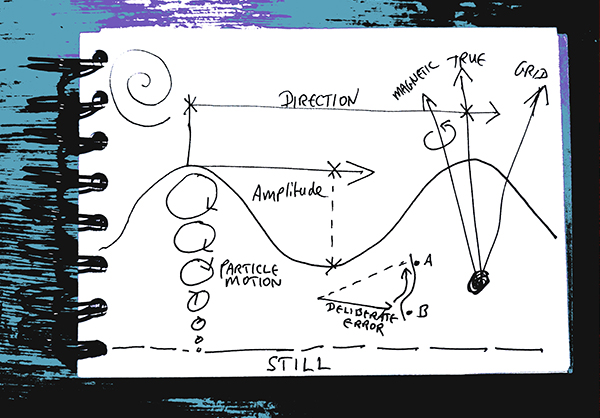
  <p>I am no longer sure of the extent that politics is immanent in any art form, in a ‘hyperpolitical’ world it would seem banal that it is. Engaging with boundaries and edges, improvising freely within both human and non-human, indeed more-than-human, forms of obstruction has a tendency to rub up against the maintenance of existing power structures, but not necessarily. Tiny movements have the potential to be revolutionary—persistence of direction pervading through oscillation, akin to Henri Lefebvre’s ‘moments’. In a world where so many are compelled to move, any alignment with the <a href="http://www.humanflow.com/action/">human flow</a> is straightforwardly political. There is certainly plenty to get upset about. It does feel a bit like liberal democratic globalist ideals are sliding backwards, does it not? What would backwards actually amount to though? A hill of beans? Geomagnetism is not the most obvious place to (re)start, but focusing on bi-polar powers way beyond human control can enlighten, in my view. Standing for peace, humanity, truth and justice is also a good place to start. Difficult, yes. Perhaps this diagram holds the key:</p>

  <p align="center"><img src="/assets/images/wavesblue-small.jpeg" alt="Waves image" /></p>

  <p>I have a vague recollection that there was an incident involving a sudden trip to my grandparents in Yeovil. I remember a sense of good-humoured panic. I think it was the first time I’d ever been to Cheddar Gorge. I only understood many years later how this was an early manifestation of DisplacementActivities at work in my life, when my father explained the urgency of his action in the light of the rapid escalation of the Cuban Missile Crisis that day. A big word ‘pride’, and I seldom venture near it, but when he told me everyone thought he was mad for doing it, I felt the tentative stirrings of that rare beast: pride in one’s father. More than that: even a supposedly secure little family living in a small town in the heart of a safe country might find themselves numbered among a band of fearful, fleeing refugees within an instant. Something not to be forgotten.</p>

  <blockquote>
    <p>“Go back. What was must never be”—Alan Garner, <em>Thursbitch</em>, 2003</p>
  </blockquote>

</div>

<div style="text-align: left; margin-top: 40px;">

  <p>vimeo: <a href="https://vimeo.com/user6604380">simon bradley</a><br />
insta/threads: <a href="https://www.instagram.com/simonbrdly">@simonbrdly</a><br />
bandcamp: <a href="https://simonbradley.bandcamp.com/">simonbradley</a></p>

  <p>collaborations:<br />
vimeo: <a href="https://vimeo.com/user127952551">ArtCouple</a><br />
bandcamp: <a href="https://essgee1.bandcamp.com/">ESS&lt;&gt;GEE</a></p>

  <p align="center"><img src="/assets/images/grant_jpeg_black.jpg" alt="Arts Council Logo" /></p>

</div>]]></content><author><name></name></author><category term="word" /><category term="projects" /><category term="research" /><summary type="html"><![CDATA[This is my previous index page. I tweaked it regularly over its existence, and now I've decided to move on. I will archive each iteration whenever I decide to move on from what was/is there. An index series.]]></summary><media:thumbnail xmlns:media="http://search.yahoo.com/mrss/" url="https://www.displacementactivities.org/assets/images/old_index_thumb.jpeg" /><media:content medium="image" url="https://www.displacementactivities.org/assets/images/old_index_thumb.jpeg" xmlns:media="http://search.yahoo.com/mrss/" /></entry><entry><title type="html">geomagnetism and ambisonics</title><link href="https://www.displacementactivities.org/sound/2025/03/21/geoambo/" rel="alternate" type="text/html" title="geomagnetism and ambisonics" /><published>2025-03-21T00:00:00+00:00</published><updated>2025-03-21T00:00:00+00:00</updated><id>https://www.displacementactivities.org/sound/2025/03/21/geoambo</id><content type="html" xml:base="https://www.displacementactivities.org/sound/2025/03/21/geoambo/"><![CDATA[<p>Very excited to receive an Arts Council Develop Your Creative Practice award (DYCP) to help me combine ambisonics with geomagnetic data, bringing global fluctuations of magnetic north into performance and sound installation. Over the coming year, I’ll be working with various specialists across several fields to explore what on/in Earth is going on and how shifting sounds can bring these hidden spatial patterns to body and ear in both new and ancient ways.</p>

<iframe src="https://www.instagram.com/p/DHdaV6kNUvu/embed" width="540" height="755" frameborder="0" scrolling="no" allowtransparency="true"></iframe>

<p>After last year’s pilot project ‘The Barrow Alignment’, collaborating with <a href="https://www.instagram.com/jathanaram/">Jonathan Lindh</a> supported by <a href="https://www.fonfestival.org/">Full of Noises</a>, I am now in a position to take the ideas much further. I’ll be working with Dr Callum Watson at the <a href="https://geomag.bgs.ac.uk/">British Geological Survey</a> in Edinburgh in order to find out what kinds of data might be useful and how his team process it creating 3D visual maps. I’ll then be discussing composition and exploring how to use the geospatial data to shift elements of sound around ambisonic/multi speaker arrays with <a href="https://www.alexanderjharker.co.uk/">Dr Alex Harker</a> at Huddersfield University. The process of crafting this work into DAW-based parameter automations will mainly be dealt with in collaboration with <a href="https://www.grietbglass.com/">Griet Beyeart</a>, who I have worked with in several sound-based projects, most recently <a href="https://essgee1.bandcamp.com/album/airborne">ESS&lt;=&gt;GEE</a>. Throughout I’ll be oscillation up and down the West Cumbrian coast to FoN in Barrow to test some of the ideas in their amazing space at Piel House, and collaborating with its architect, Jonathan Lindh (see above), ultimately producing a sharing event at FoN early next near. I’ll also be working with Bill Laybourne of <a href="https://www.workshop24.co.uk/">Worksop 24</a> finding ways to take the project even further into performance and future exhibitions/installations.</p>

<p align="center"><img src="/assets/images/grant_jpeg_black.jpg" alt="Arts Council Logo" /></p>]]></content><author><name></name></author><category term="sound" /><category term="projects" /><category term="research" /><summary type="html"><![CDATA[This introduces my Arts Council-funded DYCP project exploring Ambisonics and Geomagnetism]]></summary><media:thumbnail xmlns:media="http://search.yahoo.com/mrss/" url="https://www.displacementactivities.org/assets/images/geoambo-thumb.jpg" /><media:content medium="image" url="https://www.displacementactivities.org/assets/images/geoambo-thumb.jpg" xmlns:media="http://search.yahoo.com/mrss/" /></entry><entry><title type="html">tabula rasa</title><link href="https://www.displacementactivities.org/video/2024/10/10/tabularasa/" rel="alternate" type="text/html" title="tabula rasa" /><published>2024-10-10T00:00:00+00:00</published><updated>2024-10-10T00:00:00+00:00</updated><id>https://www.displacementactivities.org/video/2024/10/10/tabularasa</id><content type="html" xml:base="https://www.displacementactivities.org/video/2024/10/10/tabularasa/"><![CDATA[<iframe src="https://player.vimeo.com/video/1016794253" width="640" height="360" frameborder="0" allow="autoplay; fullscreen; picture-in-picture" allowfullscreen=""></iframe>

<p>This piece has been a long time in the making and unmaking. I first came across the word ‘stet’ when I was working in the print industry back in the 1980s. Hot metal was being displaced by phototypsetting and alternative ways of printing that prefigured our current reliance on digital technology. The got rid of all the wooden fonts. All the re-useable type.</p>

<p>It struck me as ironic that even the notion of ‘stet’ was being displaced. We can erase the whole of history. I recall <a href="https://youtu.be/QjYvdURv3Zw">Rollerball</a>. So funny, and yet so poignant and possibly more relevant now than it was then. Has it achieved anything? I’m not sure, other than lodging in my brain since I first saw it back in 1975, with my dad. He also liked it.</p>

<p>I think this piece forms part of ‘Lie of the Land’ series, since it combines spoken word with image and sound work while focusing on aspects of my/the past. Not quite sure what it amounts to yet, but it is useful to see them as gradually coalescing and becoming more clear. I love words, but they never quite get there. I am thinking about the quest to erase a people only becoming possible by destroying absolutely everything, especially the origins of that quest. Ho hum, back to the drawing board, to the Tabula Rasa.</p>

<p>…</p>]]></content><author><name></name></author><category term="video" /><category term="poetry" /><category term="music" /><category term="animation" /><summary type="html"><![CDATA[An ongoing theme that hasn't quite got there yet. This combines a poem with some oscillator work.]]></summary><media:thumbnail xmlns:media="http://search.yahoo.com/mrss/" url="https://www.displacementactivities.org/assets/images/tabularasa-thumb.jpg" /><media:content medium="image" url="https://www.displacementactivities.org/assets/images/tabularasa-thumb.jpg" xmlns:media="http://search.yahoo.com/mrss/" /></entry><entry><title type="html">suite six dream</title><link href="https://www.displacementactivities.org/sound/2024/04/08/suitesixdream/" rel="alternate" type="text/html" title="suite six dream" /><published>2024-04-08T00:00:00+00:00</published><updated>2024-04-08T00:00:00+00:00</updated><id>https://www.displacementactivities.org/sound/2024/04/08/suitesixdream</id><content type="html" xml:base="https://www.displacementactivities.org/sound/2024/04/08/suitesixdream/"><![CDATA[<p align="center"><img src="/assets/images/suitesix640.jpg" alt="Cover" /></p>

<p>It is now around 20 years since I produced <em>Suite Six Dream</em>, and it seems possibly more appropriate now. It is not always an easy work to listen to, given its uncompromising pursuit of the insoluble, yet there are some extraordinary peaks reached in its wasteland of noise and apparent meaninglessness. Perhaps it is one of the few works that captures a state of optimistic nihilism.</p>

<iframe style="border: 0; width: 100%; height: 120px;" src="https://bandcamp.com/EmbeddedPlayer/album=3182810470/size=large/bgcol=ffffff/linkcol=0687f5/tracklist=false/artwork=small/transparent=true/" seamless=""><a href="https://simonbradley.bandcamp.com/album/suite-six-dream">Suite Six Dream by Simon Bradley</a></iframe>

<p>&nbsp;</p>

<p style="text-align: center;">Original Text posted on 2004 site</p>
<p><strong>Description:</strong> performance project involving live improvised music dance and acting. Video projection and prepared sounds will be involved. So far there is a CD and text booklet. The complete text is available in .pdf format (333kb). A pilot version of Noiseflower was performed at Leeds Metropolitan University (Scratch July 2004) with Jack Glover, Carolyn Baker and myself. I am now putting together the next stage of performance which will involve at least two acting parts. The final product will be around 90 minutes long and would come under the general bracket of physical theatre.<br />
<strong>Objective:</strong> use improvisation, composition and aleatory techniques to weave a performance expressive of love passion anger emotion in a reified, alienated post-modern world that is at once fragmented and yet glimpses at some kind of (w)hole. Through the logic of disintegration to build something strong yet tender - beautiful yet often painful. As a child might struggle to harmonise the incommensurabilities conjured by two parents arguing themselves into divorce. The passionate ramming together of opposites. Two fists clenched bashing one another yet melting like wax into a new form that is the coming of age of the child. And she will tell the story—it is her 16th birthday after all…<br />
<strong>Essences:</strong> the peculiar feelings of fractuousness, common in the arbitrocracy, abound. The notion of atonality extends beyond microtonal polarities and merges within the fractal dialectics of the subsurd releasing a lattice of dynamic equality fields populated by potentiality spores engendered by the arbitrary couplings of simulacra. Judgement is the key.<br />
<strong>Feelings:</strong> angular, asymmetric, awry, bowed, catawampus, circuitous, cockeyed, contorted, crippled, curved, curving, deformed, deviating, devious, disfigured, distorted, errant, gnarled, hooked, incurving, indirect, irregular, kinky, knurly, lopsided, meandering, misshapen, not straight, oblique, rambling, screwy, serpentine, sinuous, skewed, slanted, snaky, spiral, tilted, topsy-turvy, tortile, tortuous, twisted, twisting, uneven, warped, winding.<br />
<strong>The Counters:</strong> Jack vocalising. I vocalising. Jack playing the clarinet. Jack playing the accordion. I playing the electric guitar. I playing the amplified cello. Additional instruments and sources feature occasionally. The sense of the word ‘counter’ is that of a draughts piece or some such singularity. The dance element would be considered as one of The Counters, similarly any actors involved would be seen so.<br />
<strong>Simulacral Counters:</strong> the various renderings and layerings of The Counters either as samples or psychic nuances. Sonic strips (as used in Noiseflower) could be seen as simulacral counters. Similarly with visual strips etc. Live audio and video sampling would provide simulacral counters during performance.</p>

<p style="text-align: center;">Book/Audio CD</p>
<p>The following sections concern the production of the audio CD. Whilst standing in its own right as a text and audio piece, it will be necessary to produce a version involving dance and acting in order to convey the full gamut of sentiment.<br />
<strong>Principles:</strong> The conveyance of text via vocal, instrumental, and compositional improvisation. Each recording has a slightly different recording process and features different arrangements of the counters. Each piece forms a concretion around an unedited improv which will provide a sonic backbone. Any structures arising will respect the backbone as a fundamental unit.<br />
Each piece had to wait for the previous one to be born before it could conceive of itself. The first one just came.<br />
All editing done on Cool Edit Pro 2, although some recordings done via Logic on Powerbook G4 with M-Audio Firewire 410 soundcard. Mics: Aiwa CM-S1 stereo, 2x PZMs, AKG S1000E condenser, Rhodes NT2 condenser. MZR700 Mini-Disc recorder.</p>
<ol>
  <li><strong>Sweat is the Rose.</strong> Initial improv: MZR700 and Aiwa CM-S1 stereo. Extra vox on AKG C1000 S to MZR700.Initial complete text presented and improvised voice(Jack) and mysely on cello. Also Jack percussed and I added vox occasionally. Then I re-recorded Jack doing the words according to the improvised cadences but made more clear. This was then looped 2 and a bit times over the initial improv.</li>
  <li><strong>Noiseflower.</strong> Recorded via 2 PZMs onto MZR700. On the eve of the textual offering we improvised obliquely for 20+ mins. During this improv I felt the urge to present the text but curbed this urge for fear of disrupting the sonic resonance. Later that evening the vocal part was solo improvised. Later the instrumental was recorded and formed the uninterrupted backbone but the vocalising had a bearing on the overall length selected. Simulacral counters were experimented with and used to ornament the final piece.</li>
  <li><strong>Mixed emotions.</strong> Recorded on Mac with 2 PZMs. I improvised Aria electric guitar and Jack vox together, I vocalised eventually. There were three(?) takes and elements from all are combined because of the interesting collisions. This illustrates the faultline theory of arbitrary music. Because it lacks tonality and rhythm it can be layered with ease. Nothing clashes because everything clashes. The interesting application of this theory is choosing just which of the infinitely accessible and possible placings/pairings sounds best. Uncannily that choice is fairly easy but this should not preclude divergent E-impositions. Hardest so far because we nearly fell out over the first improv (Jack got impatient with the guitar not letting him in – used this guitar for intro up to the point when Jack drew a halt by waving his arms and putting the word text down. Also I had doubts about the words anyway. Jack emphasised the ones I had most doubts about. The words were selected by Jack from a load of unedited stuff I sent to him= and he had recorded his own version Emotions with voice and piano but we decided to improvise this one. As it happened, we echoed his original in some of the phrases. His piece provided a race memory for us. This was not planned. Once I had decided to call it mixed emotions, I was happier with it. This was subsequent to the excruciating mix, naturally. It wasn’t all me. And that’s what emotions are. Emotions: the world chewing your soul without your permission. (Un)Fortunately, there are times when you decide to go along with it. There followed a large gap (in real life). The project faltered at this point. The whole issue of me composing Jack arose negatively. We needed to ‘regroup’. And so we didn’t meet for a while.  [There followed a 38 second interlude track, included in the album here. The original CD had 2 second gaps between the tracks.]</li>
  <li><strong>Big Space.</strong> This was beset with problems – cello pick up not working, clarinet reed broken, MZR700 ran out of power and it was the first piece that was a direct RE-action to a (the) previous one. 2 PZMs onto Mac Aiwa onto MZR700 and vox recorded separately AKG onto Mac. I recorded my vox first so as not to be contaminated by Jack. He did his cold (uncontaminated by me). With no preparation. Jack’s became the backbone. Using a Granuliser on instrumental and swapping between Mac and PC incessantly - still finding Cool Edit easier in its complexity and particularly its effects section is more comprehensible. The instrumental improv from which all the instrumentation was gathered lasted 19 minutes. It was important that the end section was not fucked around with because we conjured some extraordinary acoustic sounds. Made all the more mysterious because of the non-amplified cello being so quiet in our experience but luckily I had the presence of mind to shove the PZM onto the cello for recording purposes and this resulted in a very rich sound that was subsequently used to underscore the (almost) whole piece. The hexagram thrown was 22 with 9/moving yang in the third and sixth places moving to 24. The instrumental coda is all shot live and the clunks occur when I decided to shove the recording PZM onto the cello itself whilst I was bowing and detuning. The broken reed sound is also an authentic that Jack struggled with. I/we really felt that some spirits had arrived. We were haunted and undaunted. The Marie Celeste image. In the beginning is a vast, rolling bone ship in a midnight thunderstorm, the sirens piercing staccato penetrates the drawing room: where last I saw and smelt you. Our love that caused a tower to fall.</li>
  <li><strong>Peace: Love Volcanic Eruption.</strong> First take AKG for me and Rhodes NT2 condenser for Jack onto Mac. Two PZMs onto Mac for the instruments. Originally written for Don Myers’s eponymous painting, this piece required three voices. The previous and only performance at Don’s exhibition (Hourglass Gallery, Hebden Bridge 2000) involved Jack clarinet and voice, myself cello and voice and Monica, Don’s wife, on voice. Jack scored out the improvisations we produced and we rehearsed a couple of times before the performance (March 2000). When it became obvious that this piece should not be consigned to oblivion, it found its way into the entourage of Sweat is the Rose purely on emotional grounds. We sat the words in front of us and agreed which voices we would take. The third voice we did together. We improvised the words with no instruments. This take was distributed across the second take which involved improvised cello and clarinet and our voices. The second take remains unedited. I’m not sure how related this was to the original. Slight would be a good guess. The missing voice was found on the net and proved compliant. She took a long time to patch together since the free source at naturalvoices.att.com had a word limit. She was called Audrey and she spoke UK English, I thought of callng her CybHer. In memory of Monica.</li>
  <li><strong>an english angle.</strong> Technically this one involved many versions AKG for main vocal and PZM for instruments or Rhodes NT2 condenser for Jack’s vocal and AKG for remainder. All onto Mac. This one could not be written until the other five were complete. That was the rule. The very night I completed the five I had a dream. In the dream I was in a side room attached to a vast Jacobean hall. I was hearing between the things I was doing and I was not perturbed I was comforted but curious what was it the sound on the other side of the door. Singers were singing in the hall. Brian Blessed-type leader was leading the singing and there was sparse accompaniment with tabor, mandolin, wind pipe thing, tambour. The song he was singing had the chorus To be born an Englishman. An old english folk song. With a rhythm and tonality. A welcoming anathema to the foregoing. So the challenge had to be met. This has taken a ridiculous amount of preparation and writing prolonged by Jack’s thrice failure to turn up to scheduled meeting. In a way it’s good I’ve had time to ruminate but also I know that the cut-off is arbitrary. Had he come at the first opportunity the version would have sufficed but given this extra time I suppose it was right after big space and volcanic so I had time to refine further. No bad a thing. I added a simple drum pattern (played on an actual drum) and some bits of Beatles nipped in there somewhere but were mixed virtually out of the equation. One of the extraordinary moments in this, and possibly in the whole suite, is where an uncanny layering of blues harp, squeaky clarinet, squeaky whistle, squeaky acoustic guitar feedback and accordion seem to coalesce into something almost beautiful. I remember playing the blues harp through my (feeding back) cello strings at this point. So the return to folk roots is not so out of the question and this would be a good place to start. My folk version of Sweat is the Rose is not present in this suite but it seems to underlie posthumously the whole thing. A return to music and tunes seems inevitable now.</li>
</ol>

<p>It’s been a long, hard road and I’m deeply indebted to Jack for his ingenuity, embrace of risk, and perseverance against and with all odds. I am sure his version of events would be completely different, and maybe it will find its way to this site one day…</p>

<p>You can view/download the original text accompanying the CD
<a href="https://drive.google.com/file/d/1yE8pvh7J2XDPf2-fp3T6r9Dpb6APG2nG/view?usp=drive_link">here</a></p>

<div style="padding:64.06% 0 0 0;position:relative;"><iframe src="https://player.vimeo.com/video/749116097?badge=0&amp;autopause=0&amp;player_id=0&amp;app_id=58479" frameborder="0" allow="autoplay; fullscreen; picture-in-picture; clipboard-write" style="position:absolute;top:0;left:0;width:100%;height:100%;" title="Noiseflower, 2004"></iframe></div>
<script src="https://player.vimeo.com/api/player.js"></script>

<p>Above is an archive video of the performance at Scratch Theatre, Leeds Metropolitan University on June 16th, 2004, in collaboration with Jack Glover and Carolyn Baker,</p>]]></content><author><name></name></author><category term="sound" /><category term="album" /><category term="music" /><category term="poetry" /><category term="performance" /><summary type="html"><![CDATA[An old sound work that combined improv with structure. There is a booklet, a video of a pilot performance, and the tracks appear on Bandcamp.]]></summary><media:thumbnail xmlns:media="http://search.yahoo.com/mrss/" url="https://www.displacementactivities.org/assets/images/suitesixdream-thumb.jpg" /><media:content medium="image" url="https://www.displacementactivities.org/assets/images/suitesixdream-thumb.jpg" xmlns:media="http://search.yahoo.com/mrss/" /></entry><entry><title type="html">cause</title><link href="https://www.displacementactivities.org/sound/2024/04/07/cause/" rel="alternate" type="text/html" title="cause" /><published>2024-04-07T00:00:00+00:00</published><updated>2024-04-07T00:00:00+00:00</updated><id>https://www.displacementactivities.org/sound/2024/04/07/cause</id><content type="html" xml:base="https://www.displacementactivities.org/sound/2024/04/07/cause/"><![CDATA[<p align="center"><img src="/assets/images/bandcamp-cause640.jpg" alt="Cover" /></p>

<iframe style="border: 0; width: 100%; height: 42px;" src="https://bandcamp.com/EmbeddedPlayer/album=806439447/size=small/bgcol=ffffff/linkcol=0687f5/transparent=true/" seamless=""><a href="https://simonbradley.bandcamp.com/album/cause">Cause by Simon Bradley</a></iframe>

<p>The 1990s was a highly creative period for me, and several projects came in and out of being around this time. After the freight train of <a href="https://legsbisto.bandcamp.com/album/uncovered">Legs Bisto</a> hit the wall, I decided to try and produce a batch of saleable songs without necessarily performing them myself. The demo <em>Cause</em> (1997) was the result. The theme song <em>Natural Causes</em> had been kicking around for many years undergoing several major changes towards what I thought of as commerciality. I hope to be doing a brand new version of it later in the year, and at that point I’ll publish some of the previous versions. Either way, <em>Natural Causes</em> is a song that seems to maintain its relevance, as the world lurches from crisis to crisis.</p>

<p>It has to be said though that I am not what has subsequently become known as a ‘climate denier’, or sceptical about human involvement in climate change. The contention in ‘Natural Causes’ is partly ironic since the phrase is often used as a displacement of blame away from people or institutions; it is also a deep acknowledgement that natural powers far outweigh our potential for control, therefore we need to show a lot more respect to the world and our fellow humans—if we care to extend our stay on this beautiful planet. Perhaps it also implies that humans are indeed natural. Sadly, these issues have become subsumed beneath a woeful and toxic ‘debate’ that is accompanied by the lack of meaningful action to curb exploitation and ecological destruction. Hopefully, a new version of the song will make this abundantly clear… when it comes out.</p>

<p>I collaborated with Lucy Berrett for the main vocals for the demo, and I’ve always thought the timeless, folk-like quality of the voice suited the material exceptionally well.</p>

<p>Phil Moody on accordion and percussion together with Nick Williams on violin completed the ensemble, alongside my guitars, cello, bass, mandolin and midi programming. For some reason, ‘Griffiths’ displaced ‘Williams’ on the cover, and I have no idea why.</p>

<p>I think I managed to send the demo to half a dozen publishers and artists in the hope of some sort of a deal. After that, it has remained dormant… until now!</p>

<p>…</p>]]></content><author><name></name></author><category term="sound" /><category term="album" /><category term="music" /><summary type="html"><![CDATA[This is an old demo, made in the hope of selling a few songs. Didn't.]]></summary><media:thumbnail xmlns:media="http://search.yahoo.com/mrss/" url="https://www.displacementactivities.org/assets/images/cause-thumb.jpg" /><media:content medium="image" url="https://www.displacementactivities.org/assets/images/cause-thumb.jpg" xmlns:media="http://search.yahoo.com/mrss/" /></entry><entry><title type="html">border guide</title><link href="https://www.displacementactivities.org/video/2024/02/06/borderguide/" rel="alternate" type="text/html" title="border guide" /><published>2024-02-06T00:00:00+00:00</published><updated>2024-02-06T00:00:00+00:00</updated><id>https://www.displacementactivities.org/video/2024/02/06/borderguide</id><content type="html" xml:base="https://www.displacementactivities.org/video/2024/02/06/borderguide/"><![CDATA[<iframe src="https://player.vimeo.com/video/910535950?badge=0&amp;autopause=0&amp;player_id=0&amp;app_id=58479" width="640" height="360" frameborder="0" allow="autoplay; fullscreen; picture-in-picture" title="border guide"></iframe>

<p>This piece came as an idea when I was working with with frame guides on a video piece and observing a colour negative of a blue sky. Living between ‘The Lakes’ and the sea naturally brings most things into alignment with water. Not always blue. The ‘blue screen of death’ is a memory almost beloved, and it is strange to think that there are people around now who are familiar with computers who have never heard of it. The ongoing global shambles regarding human displacement continues to demand attention.</p>

<p>Julia Kristeva’s definition of abjection is relevant when reflecting on my frustrations here: ‘draws me toward the place where meaning collapses…’ (2002: 11); ‘…what disturbs identity, system, order…  does not respect borders, positions, rules’ (2002: 4). From citation by <a href="https://axonjournal.com.au/issues/8-1/what-rubbish/">A Frances Johnson</a>. In other words, the concept of abjection describes a sociopolitical operation performed routinely on global migrants, who are constructed as the disturbing “outside” through which the “inside” defines itself, and a place where ‘we’ can be free and safe inside any border is commonly known as a santuary. As sanctuaries diminish, our voices get higher and the fight for our fellow human beings more urgent.</p>]]></content><author><name></name></author><category term="video" /><category term="animation" /><summary type="html"><![CDATA[This is a video animation illustrating a frustration with the ongoing plight of humans searching for somewhere to live. Anywhere.]]></summary><media:thumbnail xmlns:media="http://search.yahoo.com/mrss/" url="https://www.displacementactivities.org/assets/images/borderguide-thumb.jpg" /><media:content medium="image" url="https://www.displacementactivities.org/assets/images/borderguide-thumb.jpg" xmlns:media="http://search.yahoo.com/mrss/" /></entry><entry><title type="html">lie of the land</title><link href="https://www.displacementactivities.org/word/2023/12/18/lieofland/" rel="alternate" type="text/html" title="lie of the land" /><published>2023-12-18T00:00:00+00:00</published><updated>2023-12-18T00:00:00+00:00</updated><id>https://www.displacementactivities.org/word/2023/12/18/lieofland</id><content type="html" xml:base="https://www.displacementactivities.org/word/2023/12/18/lieofland/"><![CDATA[<iframe src="https://player.vimeo.com/video/895909932?badge=0&amp;autopause=0&amp;player_id=0&amp;app_id=58479" width="640" height="360" frameborder="0" allow="autoplay; fullscreen; picture-in-picture" title="Lie of the Land #1"></iframe>

<p>This piece is part of an ongoing project that is experimenting with ways of processing archive material. The words I am reading are from a text fragment written in 1999 that arose from a ritual walk I was devising between Leeds, Bradford and Halifax. The text is still on its journey after forming the basis of ‘Mardship Bow’, a novel published on Lulu Press Inc in 2009. The images are taken randomly from my archive, focusing mainly on 1999.</p>

<p>A pdf of the text is available <a href="https://drive.google.com/file/d/14_sXCdnJ1a06xdlF366Xys0C-SXPxaPE/view?usp=sharing">here</a></p>]]></content><author><name></name></author><category term="word" /><category term="poetry" /><summary type="html"><![CDATA[This is an old text that came from the workings towards Mardship Bow, a novel based on a walk from Leeds to Halifax.]]></summary><media:thumbnail xmlns:media="http://search.yahoo.com/mrss/" url="https://www.displacementactivities.org/assets/images/lieoftheland-thumb.jpg" /><media:content medium="image" url="https://www.displacementactivities.org/assets/images/lieoftheland-thumb.jpg" xmlns:media="http://search.yahoo.com/mrss/" /></entry><entry><title type="html">two trees</title><link href="https://www.displacementactivities.org/word/2023/06/29/twotrees/" rel="alternate" type="text/html" title="two trees" /><published>2023-06-29T00:00:00+00:00</published><updated>2023-06-29T00:00:00+00:00</updated><id>https://www.displacementactivities.org/word/2023/06/29/twotrees</id><content type="html" xml:base="https://www.displacementactivities.org/word/2023/06/29/twotrees/"><![CDATA[<iframe src="https://player.vimeo.com/video/849060071?h=90f6de92d5" width="640" height="360" frameborder="0" allow="autoplay; fullscreen; picture-in-picture" allowfullscreen=""></iframe>

<p>I’ve been working on ‘Two Trees’ since 2011. It has come and gone, moved into poetry, stretched into song and soundscape, but never quite settled. In that time, a collection of tree-related pieces have coalesced, and become what I’m calling: Tree Series. In the interests of trying to get something manageable completed, I’ve been re-focusing on the Two Trees element recently. This video piece features photos from my original encounter which began on Ilkley Moor when I walked towards what I thought was a single tree on the horizon.</p>

<p>The text verion of Two Trees is avialable to download/view <a href="https://drive.google.com/file/d/1n6cbadgRucVZLC6dmVOv5lolt4YrrLKj/view?usp=sharing">here</a>.</p>

<p>Strangely enough, a few days after I published the first two sentences of this post, I turned on the radio (<a href="https://www.bbc.co.uk/programmes/m001nfzw">Poetry Please</a> 2/7/23), and Don Paterson was just about to read his poem <a href="https://www.poetryfoundation.org/poetrymagazine/browse?contentId=49796">‘Two Trees’</a> (2007). I had never come across this poem before, and listened intently. Beyond titles, I felt a curious connection between the poems. Paterson’s searing work takes an axe to poetry itself. Perhaps this distant coincidental echo will somehow reconfigure a loss doubled.</p>

<p>An inadvertant work: Two poems.</p>

<p>Today (28th September, 2023), I heard the news that the beautiful tree at ‘Sycamore Gap’ on Hadrian’s Wall has been felled. Apparently, a 16 year-old boy is implicated. No reason worth considering. The location is now one of the most painful gaps in the North East. In mourning, I will listen to Elvis, ‘Just Because’.</p>

<p>I’ll just keep adding to this as things arise:</p>

<p>A while later, Walter Renwick, a man in his late 60s, currently under suspicion, says: ‘If I’d have done a murder, I’d be getting less hassle’. People are saying the tree will now live for longer than it would have. The Gap as Spectacle.</p>]]></content><author><name></name></author><category term="word" /><category term="poetry" /><summary type="html"><![CDATA[Following an encounter on Ilkley Moor, I was inspired to write a poem. Herer is a video featuring the poem: 'Two trees'.]]></summary><media:thumbnail xmlns:media="http://search.yahoo.com/mrss/" url="https://www.displacementactivities.org/assets/images/twotrees-thumb.jpg" /><media:content medium="image" url="https://www.displacementactivities.org/assets/images/twotrees-thumb.jpg" xmlns:media="http://search.yahoo.com/mrss/" /></entry></feed>